
Super Funday · A parent’s experience
A castle made of cups, and a moment of brotherly respect
By Kevin Knight, Creator of Super Funday ·
A cup castle is a simple screen-free building activity: use lightweight cups to create walls, towers, and whatever else your child imagines. In our house, it became more than something to keep my son occupied. It gave him a creation he was proud to show his family - and prompted a small act of care from his older brother.
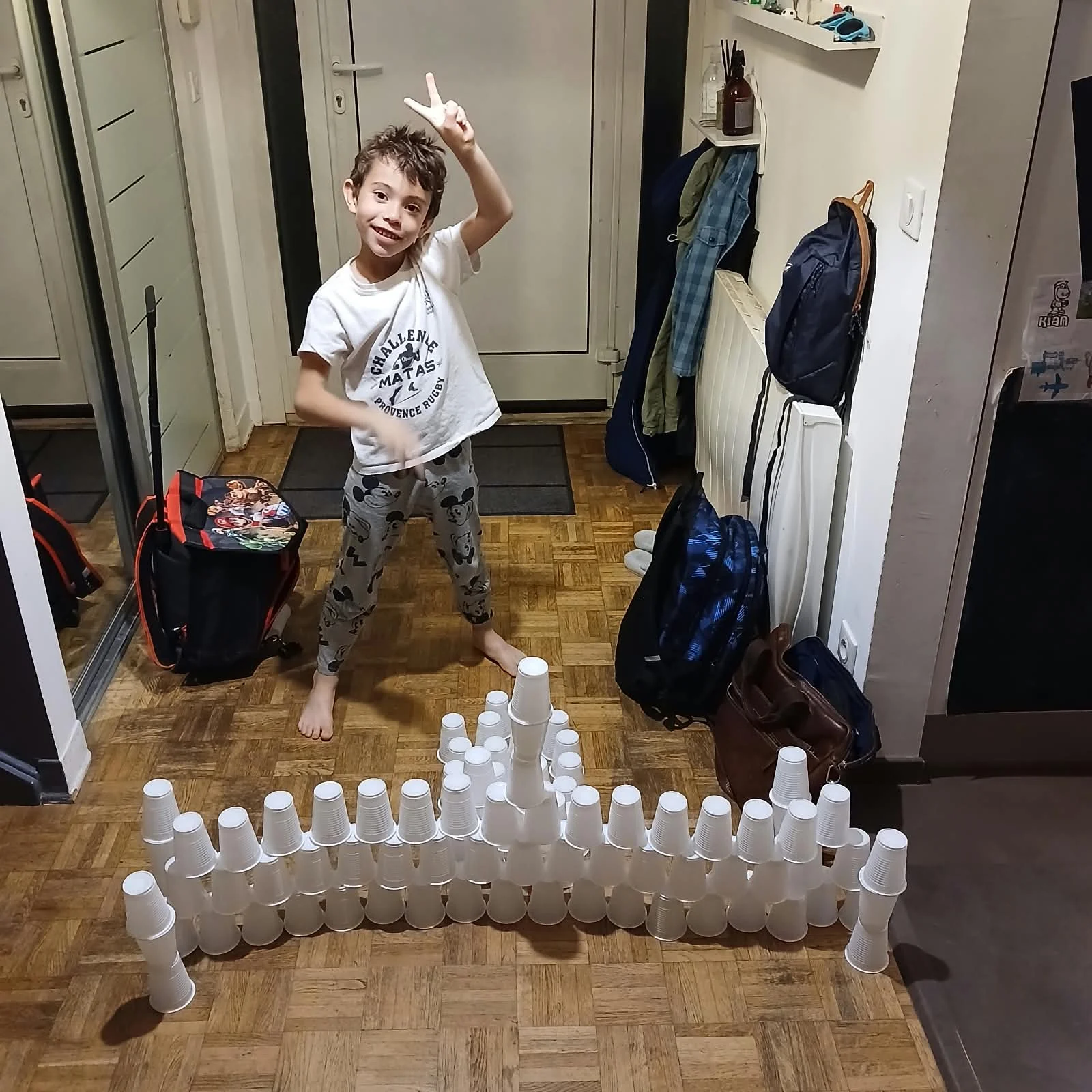
Something worth showing everyone
Building a castle with cups was one of the activities on my original handwritten Super Funday list. It needed very little to get started, but left plenty of room for him to decide what to build.
The result had long walls, towers at the ends, and a taller tower in the middle. What began as an activity to occupy him became something he wanted other people to see.
He was proud to show his older brother, his mother, and his aunt when they arrived home. That mattered to me. He had something of his own to share: a structure he had made, rather than something he had watched on a screen.
A small accident, and a thoughtful response
His older brother accidentally knocked over a few cups. He immediately rebuilt them.
That was one of the nicest parts of the experience. To me, it felt like respect for the work his younger brother had put into the castle. He treated it as something worth restoring.
The building challenge had started as one child’s project. That little moment made it a shared family story.
What goes into building a cup castle?
Looking at the finished castle, there is more going on than simply putting cups on top of one another. The following are ways to interpret the activity, rather than measurements of what it taught my son.
Concentration and careful placement
Adding a cup to a growing structure calls for attention to where it sits and how the cups below support it. A quick movement can disturb a nearby section, so there is a reason to slow down and place each piece carefully.
Balance and problem-solving
A builder has to work out which arrangements stand up. If a section falls, they can change the base, adjust the spacing, or try fewer levels. The cups give immediate feedback: the structure stays standing or needs another attempt.
Patterns, spacing, and symmetry
The photograph shows repeated rows, towers at both ends, and a taller central feature. That creates an opportunity to explore symmetry: what happens if you add a similar tower on the other side? It doesn’t need to be perfectly symmetrical to be a successful castle.
Planning and imagination
Children can decide where the walls go, how tall to make a tower, and where an entrance might fit. A cup can become part of a battlement or a lookout tower simply because they decide it is one.
Time to develop an idea
I didn’t record an exact duration for this activity. What I can say is that it occupied him and led to a finished castle he was pleased to show everyone. There was no need to turn it into a timed task: adding a wall or changing a tower could become the next small challenge.
How to try a cup castle at home
You’ll need: clean, lightweight paper or plastic cups and a stable, clear surface. Start with whatever number of cups you have; a small castle counts.
- Choose a space away from doorways, stairs, and busy walking routes.
- Begin with a short wall or a small tower.
- Let your child choose the next feature: another tower, an entrance, or a longer wall.
- If a few cups fall, try a different arrangement and rebuild.
- Make time to look at the finished creation together before putting the cups away.
For an easier version, arrange a single row of cups as a castle outline. For an extra challenge, try matching towers on either side of an entrance. Let the child decide whether they want that challenge.
Keep the structure within comfortable reach, use unbreakable cups, and keep it out of the way of people coming home. Children should never climb on the cups or use furniture to reach higher.
The castle was only part of it
There was the building, the concentration involved, and the pleasure of having something finished to show the family. Then there was his brother quietly putting the fallen cups back.
That is the kind of everyday experience that inspired Super Funday: a simple idea that gives children room to make something, take pride in it, and connect with the people around them.
Everyone congratulated him on his castle. After showing them what he had made, he calmly tidied the cups away for the evening. It was a lovely way to finish: proud of his work, appreciated by his family, and ready to put it away.
Explore Super Funday →Related reading
Read how the original activity list became Super Funday, try five screen-free activities using everyday items, or explore activities siblings can play together.