
Super Funday · Our story
How Super Funday Began: A Parent, Two Kids, and a Handwritten List
By Kevin Knight, Creator of Super Funday ·
How a sick day, 20 simple activities, and two enthusiastic children became the inspiration for a family adventure game designed to encourage more real-world play.
It started with a parent who needed a rest
Super Funday didn't begin with a business plan or a big idea for a children's app.
It began with me feeling ill and trying to keep my two energetic kids entertained long enough to get some rest.
If you're a parent, you'll probably recognise the situation. You haven't got the energy to organise an afternoon of activities, but your children still have more than enough energy for one. The easiest answer is often to hand them a screen.
I decided to try something else.
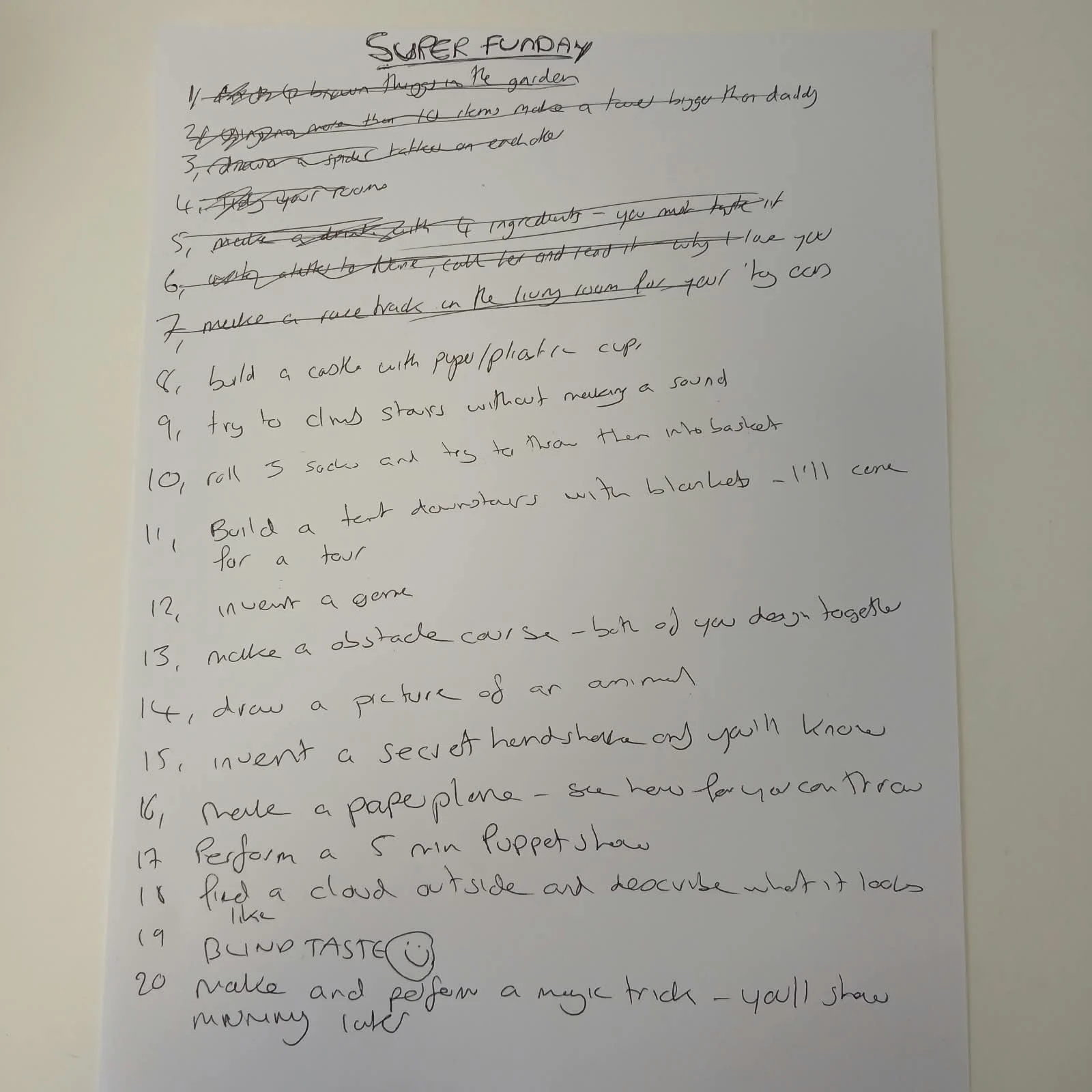
Not out of any grand ambition, but as a slightly lazy parenting experiment, I picked up a pen and wrote down 20 activities on a piece of paper.
Draw a tattoo on each other. Make a drink using four ingredients. Fold a paper aeroplane and see how far it flies. Tidy your room.
Some challenges were silly, some were creative, and a few quietly involved getting something useful done.
I read the missions and activities to them one by one, making it clear that this wasn’t a race. They could take their time and enjoy each challenge together.
They spent more than an hour and a half working through the challenges.
And the best part? They didn’t ask for a screen.
The surprise wasn't how long they stayed busy
What stayed with me most was what I didn't hear.
There was no "Can we play Switch?" No "Can we play Xbox?" No "Can we watch TV?"
Instead, they were absorbed in the challenges, cooperating, laughing, and coming up with their own ways to complete them.
The list gave them somewhere to start, but they brought the ideas and the fun.
As a parent, that felt different from simply finding something to occupy them. They were sharing an experience, using their imaginations and working together without needing me to organise every minute.
One of the activities was particularly important to me:
Call a grandparent and read them a letter explaining why you love them.
It wasn't the most exciting challenge on the list, but it added something different. The children weren't just making things or running around. They were doing something thoughtful for somebody else.
That little activity eventually became the inspiration for Super Funday's Kindness category.
The handwritten list had done its job. I'd managed to get some rest, and the children had enjoyed themselves.
But it left me wondering: could this simple idea become something other families might enjoy too?
Turning a handwritten list into an app without losing the point
Moving from paper to a phone opened up some interesting possibilities.
What if the game could choose a mission for the children? What if it could read the instructions aloud, introduce surprises, and celebrate their achievements?
But there was an obvious contradiction.
If the original idea worked because it got the children away from screens, why turn it into an app?
That question shaped much of what Super Funday has become.
I didn't want to build another game where children spend the afternoon staring at a device, tapping buttons and collecting points.
I wanted the phone to provide the idea, then get out of the way.
That's why Super Funday is built around short, real-world missions that encourage children to draw, build, explore, move, imagine, help others, and play together.
Missions can be read aloud, and the screen fades once an activity begins, so there's less reason to keep checking the phone.
The device helps start the adventure and celebrates the result afterwards. What happens in between belongs to the children.
It's a small distinction, but for me, it's the whole point.
My children became part of the development team
Building Super Funday has involved a lot of repetition.
Test and play. Listen. Adjust. Test and play again.
My children, now nine and seven, have played every mission and shared their thoughts throughout development.
And they've approached the game in very different ways.
My nine-year-old often looks at the bigger picture.
Would his friends enjoy this mission? How would they play it? Would it still be fun with other children?
His questions pushed me to think beyond our own household and consider how different families might play together.
My seven-year-old had another concern.
"What do the avatars do?"
It was a simple question, but an important one.
I'd been thinking about characters as a fun reward for completing missions. He wanted to know what they actually did and why he should be excited to unlock them.
It reminded me that children don't necessarily see a game the way an adult designing it does.
My youngest son also struggled to understand the missions at times. That helped shape the voice option, which reads a mission aloud, and an “I forgot what they said” option so he could hear the instructions again when he needed them.
Something that seems obvious to me might need explaining. Something I consider a small detail might be the very thing that interests them most.
Their feedback has helped shape the missions, characters, rewards, and overall experience.
They haven't simply been testing a finished product.
They've been helping decide what Super Funday should become.
Giving parents the freedom to make it their own
The first handwritten list worked because I'd made it for two children I knew very well.
I knew what would make them laugh, what might keep them interested, and which little challenges they would find exciting.
An app can't know every family like that.
And I don't think it should try to.
That's why Super Funday includes the ability for parents to create their own missions and personalise rewards.
Maybe your child loves dinosaurs, football, dancing, or inventing stories. You can build activities around those interests.
The same goes for rewards.
It could be a special pasta night, choosing the next family outing, or getting to decide what everyone does on Sunday afternoon.
It could even be movie night.
That might sound strange for a game intended to encourage less screen time, but I'm not trying to make screens the enemy.
I'm trying to give families more ways to spend time together, and to encourage children to be imaginative, collaborate, and bring their own ideas to the activities.
Sometimes that means running around the house on a ridiculous mission. Sometimes it means sitting down to watch a film as a family.
Parents know their children, and I want them to have the freedom to decide what works.
My own kids love sport, so I also added a sports equipment checklist in the parent settings. Parents can enable or disable missions that use a trampoline, rugby ball, football, tennis ball, or other equipment, depending on what they have available. It’s another way to make the game fit the family playing it.
A game children enjoy, built around a parent's priorities
Throughout development, I've tried to balance two things.
First, Super Funday needs to be genuinely fun for children. If they don't enjoy the missions, nothing else matters.
But as a parent, I also want to know whether it's doing what I originally hoped: encouraging real-world activities rather than more time looking at a screen.
The parent dashboard helps me understand how the game is being used.
In our recorded play sessions so far, 68% of play time has been spent with the screen faded.
That doesn't mean Super Funday has reduced my children's overall daily screen time by 68%. It doesn't measure that, and I wouldn't pretend otherwise.
What it tells me is that, during those sessions, the game has spent most of its recorded time in a state designed to encourage children to focus on what they're doing away from the phone.
For me, that's an encouraging sign.
There's another principle I've wanted to keep from the beginning.
No ads. No tricks.
I'm building Super Funday as a parent who wanted to create a better afternoon for his children. I want families to enjoy the game because of the experiences it helps create, not because it finds ways to keep children glued to the screen.
Growing with the everyday challenges of family life
Family life has a habit of providing new ideas.
Anyone who's taken children on a long journey knows the familiar question:
"Are we there yet?"
And anyone who's sat in a restaurant with hungry children waiting for their food knows how slowly those minutes can pass.
Those moments made me think about how the original Super Funday idea could work in different situations.
Road Trip brings missions into car journeys, with activities designed around the experience of travelling together.
Restaurant Rescue, which is still in development, explores quieter, seated challenges that children can enjoy while waiting for food.
The idea behind both is the same as that first handwritten list: give children a little inspiration at the right moment and see where they take it.
As Super Funday grows, my children will continue helping shape it. They'll try new missions, ask unexpected questions, invent things I hadn't considered, and tell me when something isn't fun.
I know not every mission will work for every child or every afternoon.
Sometimes an idea lands beautifully. Other times, you need to try something different.
That's part of family life, and it's why giving parents and children a choice matters so much.
From 20 handwritten activities to Super Funday
When I look back at that first afternoon, what stays with me is how much the children created from those simple ideas.
I didn't create an elaborate game. I didn't buy anything or organise a complicated activity.
I gave them 20 ideas on a piece of paper.
They supplied the imagination, cooperation, laughter, and occasional chaos.
Super Funday has grown a long way from that original list, but the idea behind it hasn't changed.
It's a game created for kids, shaped with kids, and built around a parent's hope that a little help getting started can lead to more fun together.
The phone starts the adventure. The children bring it to life.
Start your own family adventure
You don't need an elaborate plan to create a memorable afternoon with your children. Sometimes all it takes is one simple challenge.
Explore Super Funday to discover the family adventure game inspired by our original handwritten list, or start with a pen and paper and see what your children come up with.