
Create · A family story
Build a Bridge: Why the Making Matters More Than the Engineering
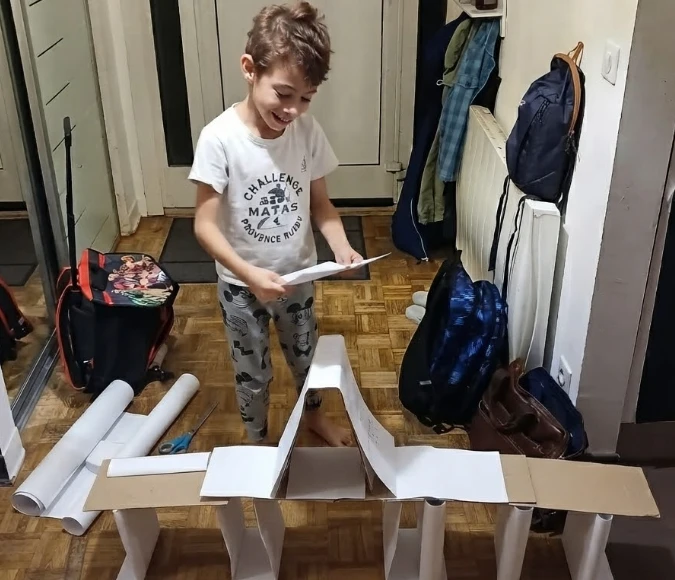
When our seven-year-old came to the Create category and saw the “Build a Bridge” challenge, he did not need a long explanation. He got stuck in. Before long, paper was spread across the floor and he was shaping a route between the supports, watching how each part held together.
We were not trying to teach engineering. We were not checking whether he knew the right design, or waiting for a perfect bridge. We wanted to see where the challenge would take him.
A small prompt, with room to take over
The app’s bridge mission gives a child a starting point: use two sheets of paper to build a bridge between two books, then see if it can hold a pencil for five seconds. It is specific enough to begin, but the child still has decisions to make. How should the paper sit? What could make the middle stronger? What happens if the first idea bends?
In the photo, Kian’s building grew into a bigger floor project. That is part of what I loved: the prompt had got him moving, and then his own curiosity expanded the activity. We did not need to steer him toward one correct construction.
What scaffolding looked like in our living room
In education, “scaffolding” is often used to describe giving someone enough support to take a next step, then letting them do more of the work themselves. In our case, the mission supplied the first step and a simple test. Kian supplied the ideas, the trial and error, and the enthusiasm to keep building.
That is my way of describing the moment afterwards. We were not deliberately applying a teaching method. We offered a manageable invitation and made room for him to explore it. If he had asked for help, we could have held a book steady or asked what he wanted to try next. We did not have to take over and design the bridge for him.
The useful balance, for us, was having enough structure to get started without turning the challenge into a lesson with a prescribed answer.
We cared about the process, not a perfect bridge
There was no score for the most elegant design. We did not need to explain forces or load-bearing structures. The point was that Kian was making something, noticing what happened and choosing what to do next.
A bridge that bends is still a useful part of the adventure. It gives a child something to notice. Maybe the paper needs a fold; maybe the supports need to move closer; maybe the next version should be completely different. Or maybe the child is happy with the attempt and ready to move on.
Adults can be tempted to jump in with the clever fix. Sometimes it is more interesting to ask, “What do you think might happen if…?” and wait. Sometimes the best response is simply to watch and let the child lead.
Try the paper bridge challenge
What you need: two sheets of paper, two books and one pencil.
Try this: place the books a short distance apart. Use the paper to make a bridge between them, then see whether it holds a pencil for five seconds.
Keep the books stable and use a clear, comfortable workspace. If the bridge does not hold, invite your child to change one thing and test again. There is no need to turn it into a competition or insist on repeated attempts.
Let the child own the next idea
For us, the Create category is not about producing something impressive for an adult. It is an invitation to make, adapt and explore with ordinary materials.
Kian leapt into the bridge challenge because the first step was clear. What happened after that belonged to him. We were happy to follow his process wherever it went, without worrying about whether we were building an engineer.
Sometimes a sheet of paper, two books and a pencil are enough to get a child started. The rest is theirs to discover.
The phone gives them the idea. They create the adventure.
Explore the Create category and try a free sample mission together.
Try a free mission → Explore free printablesMore simple family challenges
Read about Kian’s three-sock and plastic-cup game, explore screen-free activities for kids, or see how Super Funday began.